If you’re building an AI assistant from website content, the information you need may already be published. Getting that information into a usable form can mean copying pages by hand, stripping navigation and repairing broken formatting before the actual project begins.
Firecrawl is worth considering when that collection work needs to be repeatable. It turns web pages into Markdown through an API, with a separate crawler for collecting multiple pages. For developers and digital agencies building knowledge assistants, the appeal is straightforward: spend less of the project maintaining the web-data plumbing.
Disclosure: ApexTool is a Firecrawl affiliate and may earn a commission from qualifying purchases through our referral link.

Who should shortlist Firecrawl?
Developers and digital agencies with recurring collection work. If website content is a regular input to your product or client workflow, an API gives you a repeatable starting point. Try a representative sample, then compare the subscription and integration effort with maintaining your own extraction code.
Teams that need structured source material, not just a pasted paragraph. Markdown can preserve headings and links in a form your integration can inspect and process.
For an occasional page you can comfortably copy by hand, a paid scraping service may be unnecessary. If your CMS already exports the exact content you need, test that route first. And if you expect a finished chatbot, budget for the remaining work: selecting content, retrieval, answers and evaluation are separate from collecting pages.
A useful fit for the work between a website and an AI assistant
Imagine a digital agency building a support assistant from a client's public help centre. The answers already exist, but they are spread across pages. Copying them once might be manageable. Repeating the job after documentation changes is less appealing.
Firecrawl provides a programmable collection step. Its Scrape endpoint returns a page as Markdown, HTML or other supported formats; its documentation also describes JavaScript rendering and handling dynamic pages. You can try a page in the Playground before building an integration. Scrape documentation
For a site-wide job, Crawl follows links and collects pages. Set an explicit page limit before starting: a small sample is enough to find out whether your content comes through properly. Crawl documentation
The recurring benefit is a collection step you can build into the client workflow: fetch the permitted pages again when documentation changes, rather than copy and reformat each one by hand. You still decide which pages belong in the knowledge base and how the assistant should use them.
What our one-page test showed
On 2 November 2026, Brisbane time, we sent one public ApexTool article to Firecrawl's documented no-key Scrape endpoint. We requested Markdown with the main-content option enabled. We did not create an account or connect a payment method.
The request succeeded. The response reported a 200 status for the source page and returned 4,991 characters of Markdown. The output retained the article heading, section headings, links, image references and captions.
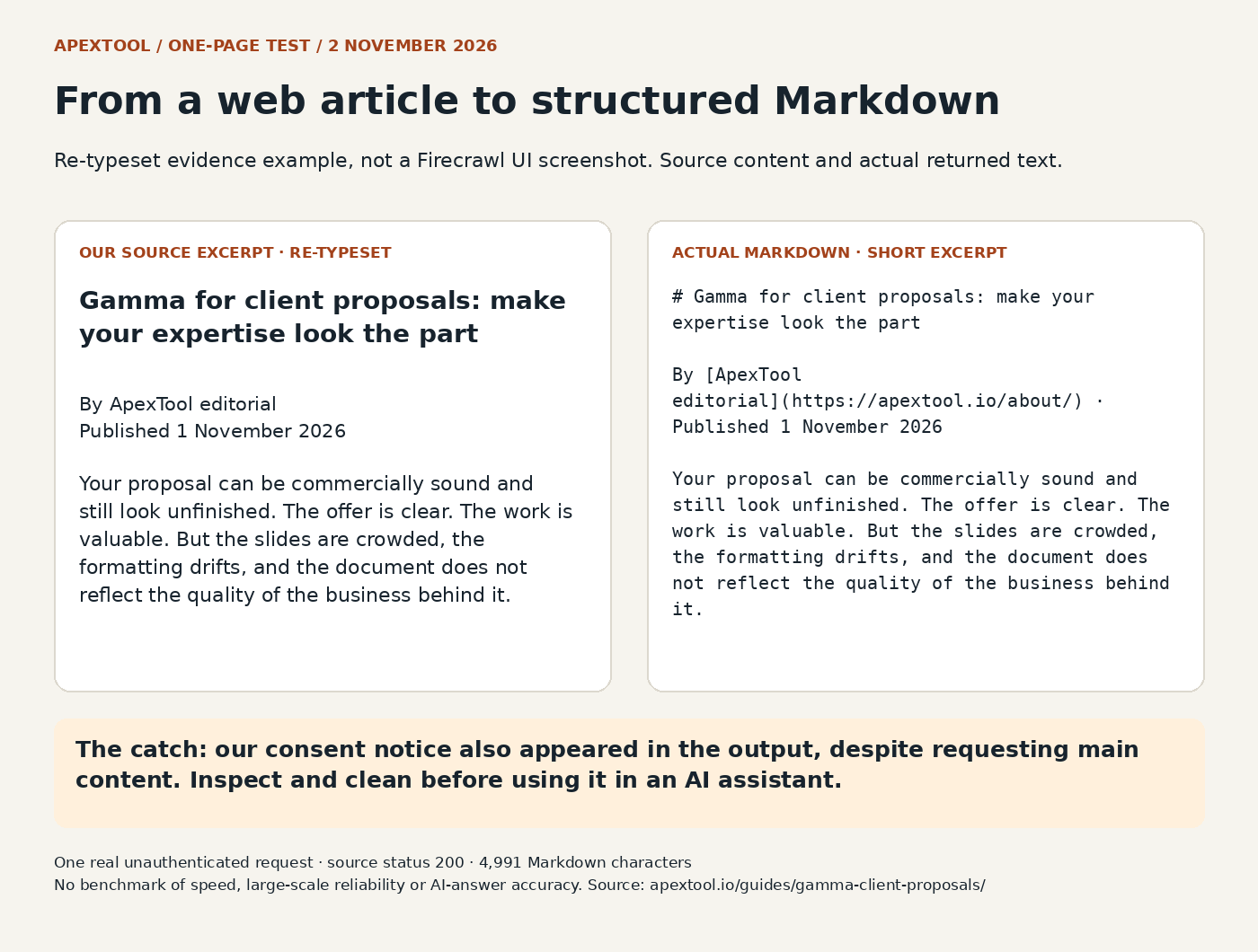
That is a useful result if your next step needs readable text with its structure intact. It also shows a limitation worth catching early: the output included our analytics-consent notice ahead of the article, despite the main-content setting.
This single-page test does not establish performance on complex apps, protected pages or a large help centre, or show that an assistant would answer questions more accurately.
What the first paid step costs
At the time of checking, Firecrawl lists a free tier with 1,000 credits each month and no card required. Hobby includes 5,000 monthly credits for US$19 billed monthly, or US$16 per month billed annually. The annual price means an annual commitment, not a US$16 month-to-month plan. Current pricing
Basic Scrape and Crawl requests cost one credit per page. Some options add charges: JSON extraction adds four credits per page, for example. A returned error page can also consume credits. Use the billing rules for the options you actually need, rather than treating every credit as a guaranteed usable document. Billing details
Paid plans can add pay-as-you-go credits when the included balance runs out. Review the spending limit before running a larger job; the pricing page explains how to cap that spending or turn it off. Pay-as-you-go controls
Use the free allowance to try a representative page you own or have permission to process. Check the source-page status and whether the important text, links and tables survived without unrelated notices. If that result holds up, decide whether repeatable collection is worth the subscription for your workflow. Request and response details
Our recommendation
For developers and digital agencies regularly turning public website content into source material for an assistant, Firecrawl offers a programmable alternative to repeated manual collection. If your own sample meets your requirements, it belongs on your shortlist.
Try your own page with Firecrawl →
Sources and prices checked 2 November 2026, Brisbane time.